选择地区语言
Sikun 1000 adopts fluorescence sequencing technology and algorithms based on DNA amplification on the chip surface. It identifies and processes the optical signals of bases to generate image data, and finally obtains the corresponding gene sequence
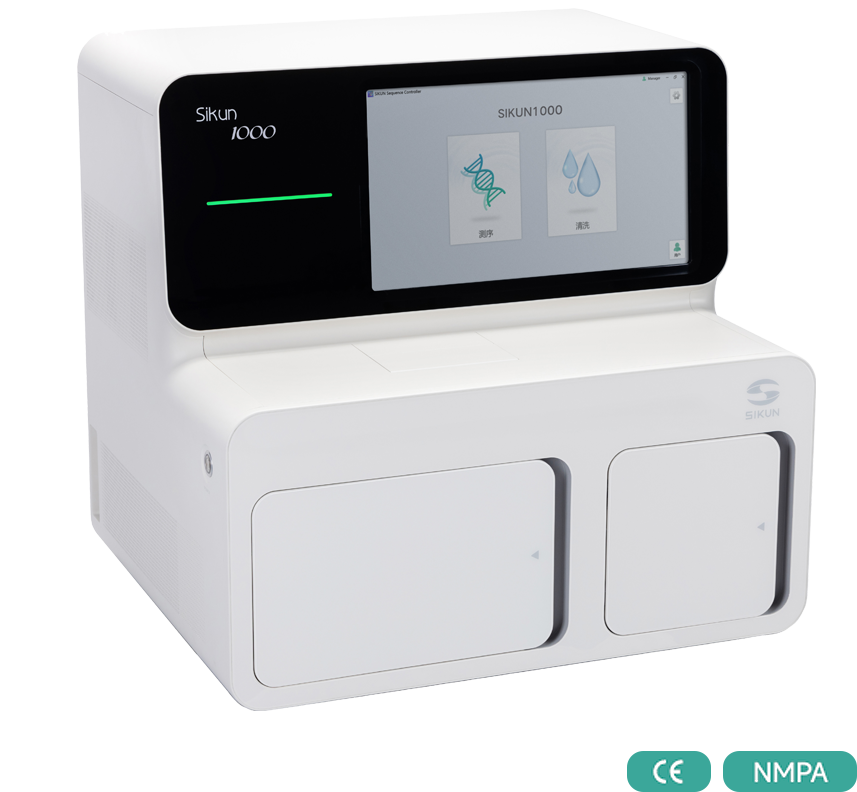
Product Features
Excellent data quality, with an accuracy rate exceeding 99.9%.
Sequencing can be completed in 2.5 h.
An open platform, supporting multiple sequencing modes and adapting to various application needs.
Stable performance with strict quality control, delivering consistent and reliable results.
Specifications
| Performance Description | Parameters |
|---|---|
Flow Cell Type | Mid Output 110M Reads High Output 330M Reads |
Data Output | Mid Output 5.5-33 Gb High Output 16.5-100 Gb |
Sequencing Time | 2.5-24 h |
Data Quality | Q30>85%-90% |
Dimensions | 825×687×788 mm |
Net Weight | 155kg |
*Note: The above indicators are based on the enterprise's reference sequencing case. In actual application, they are affected by factors such as sample type, quality, fragment size, and loading concentration. Performance may vary accordingly.
Performance Parameters
Notes:1.The maximum value of effective reads is obtained under standard protocol operation; the recommended loading density is 260–300 K/mm². In actual applications, it will vary depending on sample type and library preparation method.
2.The Q30 base percentage (above the standard threshold) is an average derived from a full run of standard libraries. Actual performance may differ in real-world use, depending on sample type, library quality, insert fragment length, and other variables.
3.The runtime refers to the total duration from sample loading on the machine, library amplification (approximately 1-2 h), sequencing, to data analysis. All steps are completed within a single machine.
4.The chip is processed with double-surface modification technology, allowing both its upper and lower surfaces to be used for simultaneous amplification and sequencing.
Related products
Technical Document