选择地区语言
Next-Generation Benchtop Low-Throughput Sequencer
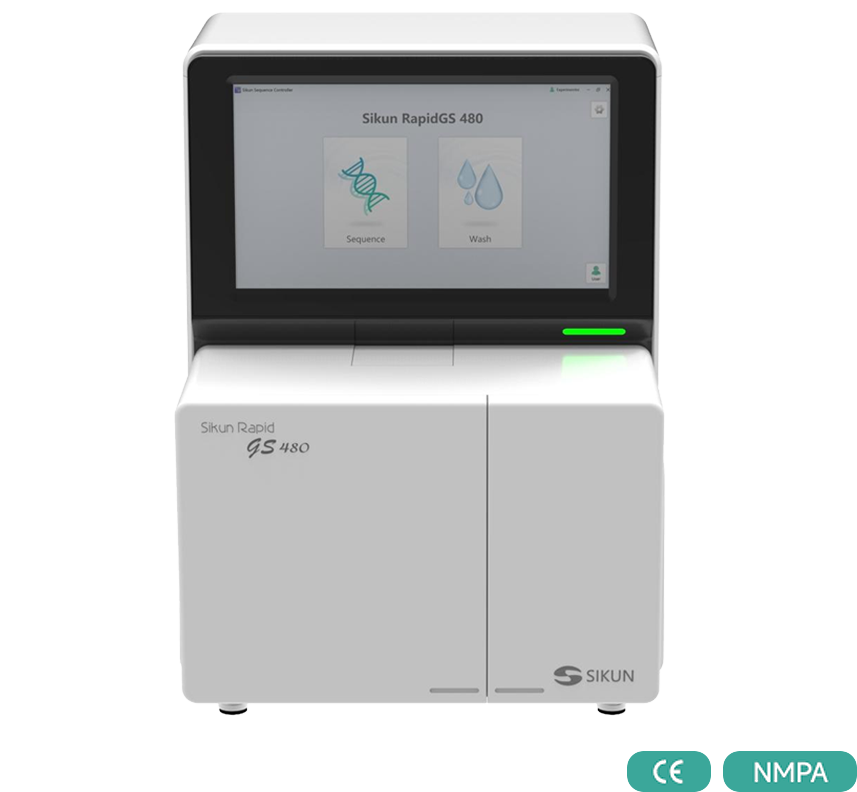
Product Features
Precision Customization, Agile Adaptation
Rapid Turnaround, Industry-Leading Speed
Minimalist Interaction, Easy to Use
Robust & Reliable, Consistent Performance
Specifications
| Performance Description | Parameters |
|---|---|
Flow Cell Type | 10M/30M/50M/80M/160M Reads |
Data Output | 0.5-48G |
Sequencing Time | 2.0-24 h |
Data Quality | Q30>85%-90% |
Dimensions | 618×616×808 mm |
Net Weight | 105kg |
Note: The above indicators are based on the enterprise's reference sequencing case. In actual application, they are affected by factors such as sample type, quality, fragment size, and loading concentration. Performance may vary accordingly.
Performance Parameters
| Flow Cell Type | Read Length | Data Output | Sequencing Time | Sequencing Quality |
|---|---|---|---|---|
| 10M Reads | SE50/SE75/SE100/PE150/PE300 | 0.5-6G | 2-28.5h | >80%~90% |
| 30M Reads | SE50/SE75/SE100/PE150/PE300 | 1.5-18G | 2.1-33h | >80%~90% |
| 50M Reads | SE50/SE75/SE100/PE150 | 2.5-15G | 2.5-22.5h | >85%~90% |
| 80M Reads | SE50/SE75/SE100/PE150/PE300 | 4-48G | 3-41.5h | >80%~90% |
| 160M Reads | SE50/SE75/SE100/PE150 | 8-48G | 3-22.5h | >85%~90% |
Notes:
1. The maximum value of effective reads is obtained under standard protocol operation; the recommended loading density is 260–300 K/mm². In actual applications, it will vary depending on sample type and library preparation method.
2. The Q30 base percentage (above the standard threshold) is an average derived from a full run of standard libraries. Actual performance may differ in real-world use, depending on sample type, library quality, insert fragment length, and other variables.
3. The runtime refers to the total duration from sample loading on the machine, library amplification (approximately 1-2 h), sequencing, to the generation of Basecalling data via data analysis.
Technical Document